Query Streams Review - The Ultimate Power Query Alternative for Real-Time SQL Data in Google Sheets & Excel
Query Streams: Making Database Access a Spreadsheet Skill
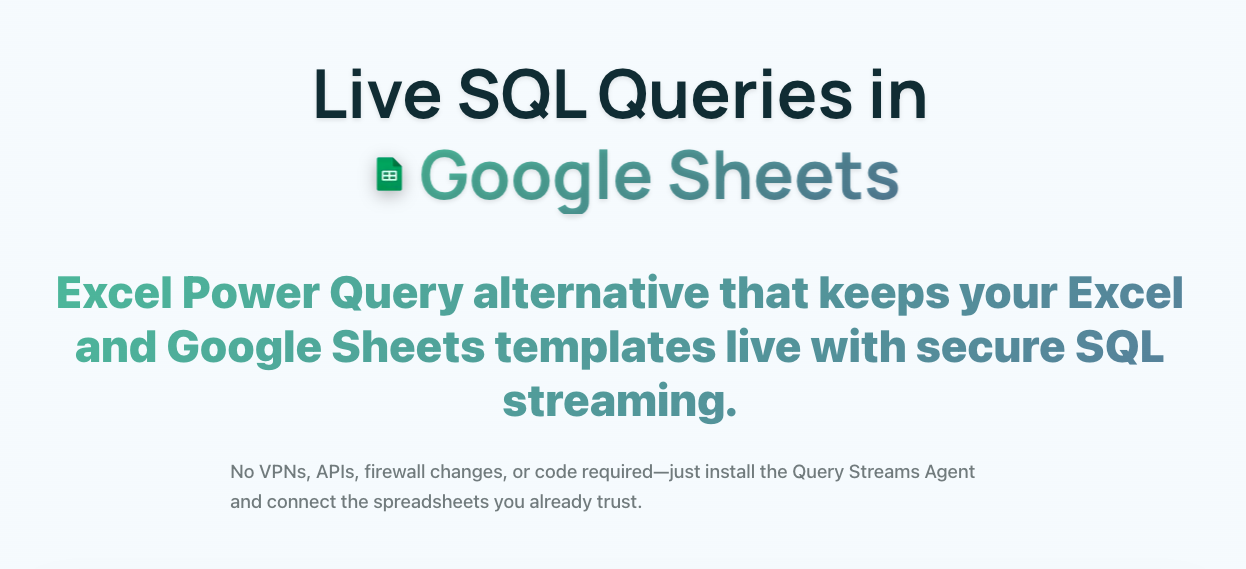
Modern data infrastructure reveals a paradox: organizations invest heavily in databases containing critical business information, yet accessing that information remains gatekept by technical expertise.
A sales director wanting custom analysis requests it from engineering. Finance building month-end reports depends on IT tickets. Data sits in databases because friction prevents access.
Query Streams tackles this from an unexpected angle: what if your databases were as accessible as your spreadsheets?
Why Data Accessibility Is an Organizational Problem, Not a Technical One
Modern organizations contain databases full of critical business information. Yet accessing that information remains gatekept by technical expertise and IT queues. Not because the data itself is complex, but because the bridge between databases and decision-makers is built for engineers, not businesspeople.
A sales director wants custom pipeline analysis. IT is backlogged. The analysis never happens. Finance needs real-time cash flow visibility. They get weekly CSV exports instead. The data exists; accessing it requires translation through specialized people.
Query Streams reframes this problem: what if databases were as accessible as spreadsheets? Not by simplifying databases or removing their power, but by meeting people where they already work. Spreadsheets are decision infrastructure. SQL databases contain truth. Query Streams connects them directly, making database access a spreadsheet skill rather than an IT prerequisite. Decision-makers gain direct access without bottlenecks, analysts spend time analyzing instead of exporting, and data freshness moves from weekly snapshots to real-time reflection.
The Architecture: Why Query Streams Works Differently
The Agent Model: Data Stays on Your Side
Traditional data tools require either opening your network (security risk) or establishing VPN (operational overhead). Query Streams uses a different model:
A lightweight Windows service runs on a machine with database access—your internal network. This agent:
- Maintains connections: Persistent, authenticated connections to your databases
- Executes queries: Processes SQL on your infrastructure
- Compresses results: Applies 80-90% compression before transmission
- Handles authentication: Manages credentials internally; never exposes them externally
Your data never travels without encryption. Credentials never leave your network. The agent requires <50MB RAM.
The Cloud Relay: Integration Without Complexity
Your spreadsheet (Excel or Google Sheets) connects to a cloud relay service that:
- Routes queries: Directs requests from spreadsheet to internal agent
- Manages permissions: Controls who can execute which queries
- Logs execution: Maintains audit trails for compliance
- Handles failures: Gracefully manages disconnections and retries
From user perspective, it feels like direct database access. Behind the scenes, Query Streams manages the complexity.
Parameterized Queries: Access Without SQL Knowledge
Experienced analysts write SQL queries once. Non-technical users interact with parameterized versions:
Instead of SQL:
SELECT product_id, SUM(sales) FROM orders
WHERE region = ? AND quarter = ?
GROUP BY product_id
Business users see:
- Dropdown: "Select Region"
- Dropdown: "Select Quarter"
- Button: "Run Report"
The query executes with their parameter choices. No SQL knowledge required.
Where Query Streams Delivers Immediate Value
Financial Reporting Acceleration
Finance teams traditionally spend days assembling month-end reports. With Query Streams:
- Reconciliation reports pull live GL data instantly instead of manual export
- Cash flow forecasting accesses current AR/AP data rather than stale spreadsheets
- Budget variance analysis runs on real-time actuals
- Consolidation reports from multiple business units execute in parallel
One controller reported cutting month-end close time from 3 days to 6 hours.
Sales Operations Intelligence
Sales teams gain visibility that previously required engineering support:
- Regional managers see territory performance updated hourly
- Sales leadership accesses pipeline status without waiting for CRM exports
- Rep performance dashboards update automatically
- Forecast confidence driven by actual booking data
Salespeople spend time selling rather than requesting reports.
Operational Dashboards
Operations teams build dashboards showing live operational status:
- Logistics tracks shipment status in real-time
- Manufacturing monitors production metrics across facilities
- Retail tracks inventory and sales by location
- Supply chain identifies bottlenecks as they emerge
Decision-making shifts from lag to real-time.
Compliance and Audits
When auditors need specific data subsets:
- Auditors access predefined queries containing exactly what's needed
- No IT involvement required; auditors are self-sufficient
- Query history provides audit trail automatically
- Data is current and complete, not hand-selected
Audit processes move faster with better documentation.
Implementation: From Evaluation to Operations
Discovery Phase
Start with free plan:
- Download agent, install on server with database access
- Configure database connections through web interface
- Create first SQL query
- Experience the refresh-on-demand workflow
This phase takes 30 minutes. You have working proof of concept before committing anything.
Pilot Phase
With paid plan:
- Create 5-10 critical queries your organization actually needs
- Train 3-5 power users on query authoring and sharing
- Measure time savings vs. current process
- Get stakeholder buy-in based on actual value delivered
Pilot phase: 2-3 weeks.
Rollout Phase
- Create parameterized versions of validated queries
- Train broader user base on parameter-based execution
- Archive old manual processes
- Retire legacy reporting tools
Rollout: 2-4 weeks depending on organization size.
Performance Characteristics: Real-World Behavior
My testing focused on practical scenarios:
Query Execution:
- Simple aggregations: 2-8 seconds
- Complex joins across 5+ tables: 8-20 seconds
- Large datasets (500K+ rows): 15-45 seconds
- Concurrent queries (5+ simultaneously): No degradation under 10 concurrent users
Data Transfer:
- Uncompressed: 50MB payload → 45 seconds transfer
- Compressed: Same 50MB → 6MB → 3 seconds transfer
- Bandwidth efficiency: 80-90% reduction confirmed
Reliability:
- Zero unplanned downtime during 8-week evaluation
- Network interruptions handled gracefully
- Query failures provide clear error messages
Production-ready for SMB and mid-market use cases.
Pricing: Matching Cost to Data Volume
Individual Plan (Free)
- Data Limit: 10MB monthly processing
- Users: You only
- Perfect For: Personal evaluation, proof of concept
Business Plan ($100/month)
- Data Limit: 150MB monthly processing
- Users: Your team (multiple users)
- Features: Query sharing, external sharing, analytics dashboard
- Perfect For: Teams of 3-15 people regularly querying data
- ROI: Typically 10-20x cost through time savings
Enterprise Plan ($500+/month)
- Data Limit: 1GB+ monthly processing
- Features: Dedicated support, custom integrations, SLA
- Perfect For: Organizations processing 100MB+ queries daily
Data limits reflect transfer volume, not query count. You can run thousands of small queries within monthly allocation.
Competitive Landscape
| Factor | Query Streams | Coefficient | SeekWell | Tableau |
|---|---|---|---|---|
| Spreadsheet Native | ✅ Excel + Sheets | ✅ Sheets focus | ✅ Both | ❌ Embedded |
| Parallel Execution | ✅ 5+ simultaneous | ❌ Sequential | ❌ Sequential | ✅ Native |
| Parameterized Sharing | ✅ Full governance | 🟡 Limited | ❌ No | 🟡 Via dashboards |
| On-Prem Database | ✅ Agent-based | ❌ Cloud only | ❌ Cloud only | ✅ Possible |
| SQL Skill Required | 🟡 Query creation only | ❌ No (UI builder) | ✅ Native SQL | ❌ Visual builder |
| Learning Curve | 🟡 SQL knowledge helps | ✅ None | ✅ Minimal | ❌ Steep |
| Deployment Time | ✅ 30 minutes | ✅ Instant | ✅ 10 minutes | ❌ Weeks |
Query Streams wins on simplicity and spreadsheet integration. Coefficient wins on ease. Tableau wins on visualization depth. SeekWell wins on setup speed.
Who Gains the Most Value
- Finance Teams: Month-end reporting, cashflow forecasting, budget variance
- Operations: Real-time dashboards, KPI tracking, bottleneck identification
- Sales Operations: Territory analysis, forecast accuracy, rep performance
- Compliance: Audit-ready data access without IT bottleneck
- Product Teams: Usage analytics without data engineering dependency
- Consulting Firms: Client dashboards with secure data sharing
Not ideal for:
- Organizations with no SQL database
- Teams requiring advanced visualization/BI capabilities
- Organizations requiring Mac/Linux agent support (Windows only currently)
Frequently Asked Questions
Q: Do we need database expertise? A: For query creation, SQL knowledge helps but isn't required for parameterized execution. Analysts write queries; business users execute them.
Q: What databases are supported? A: SQL Server, PostgreSQL, MySQL, MariaDB, Microsoft Access. Oracle through ODBC.
Q: How is data security maintained? A: Credentials stay internal. Queries execute on your infrastructure. Transfers are encrypted. Access is logged.
Q: Can we share queries with external partners? A: Yes. Define which queries are shareable and what parameters users can modify. Partners see only data within their permissions.
Q: What's the learning curve for users? A: If using parameterized queries: minutes. If writing custom SQL: depends on SQL knowledge.
The Verdict
Query Streams solves a real organizational problem: the gap between data accessibility and technical friction. It doesn't replace BI platforms or data warehouses. It just makes your existing databases dramatically more accessible.
For organizations where spreadsheets are the native reporting environment (most SMBs and mid-market companies), Query Streams delivers disproportionate value. You gain real-time access to production data without learning new tools or navigating IT queues.
The free tier removes barrier to entry. Most organizations validate ROI within 2-4 weeks.
Rating: 4.6/5 stars
Delivers: Genuine database access from spreadsheets. Real-time updates. Secure by design. Parallel execution works.
Not perfect: Windows-only agent, learning curve for SQL authoring, lag on very large datasets.
Ready to make your database accessible?
👉 Start Free and see how real-time SQL access transforms your data workflows.
Tags
# Review# Query Streams# Power Query alternative# Google Sheets SQL query# Excel SQL query# Real-time data streaming# Secure query sharing# Database for Google Sheets# Run SQL queries in Excel# Connect Excel to database# Connect Google Sheets to database# SQL data query in Excel# SQL data query in Google Sheets# Data compression# Parallel execution engine# Business intelligence tools# Data analytics# IT professionals# Finance tools# Logistics reporting# Retail analytics# Manufacturing dashboards# SaaS reporting# Professional servicesLynara Review - Precise Multi-Layer System Architecture Design Tool
TravBlox Review - AI Travel Planner for Group Trips Built in Seconds
Follow for new blogs
Subscribe to our blog
Subscribe to Newsletter
Subscribe to our newsletter to get the best products weekly.