Zenor AI Review - Multimodal AI Shopping Assistant for Shopify Stores
Zenor AI: The Bridge Between How Customers Think and How You Organized Your Inventory
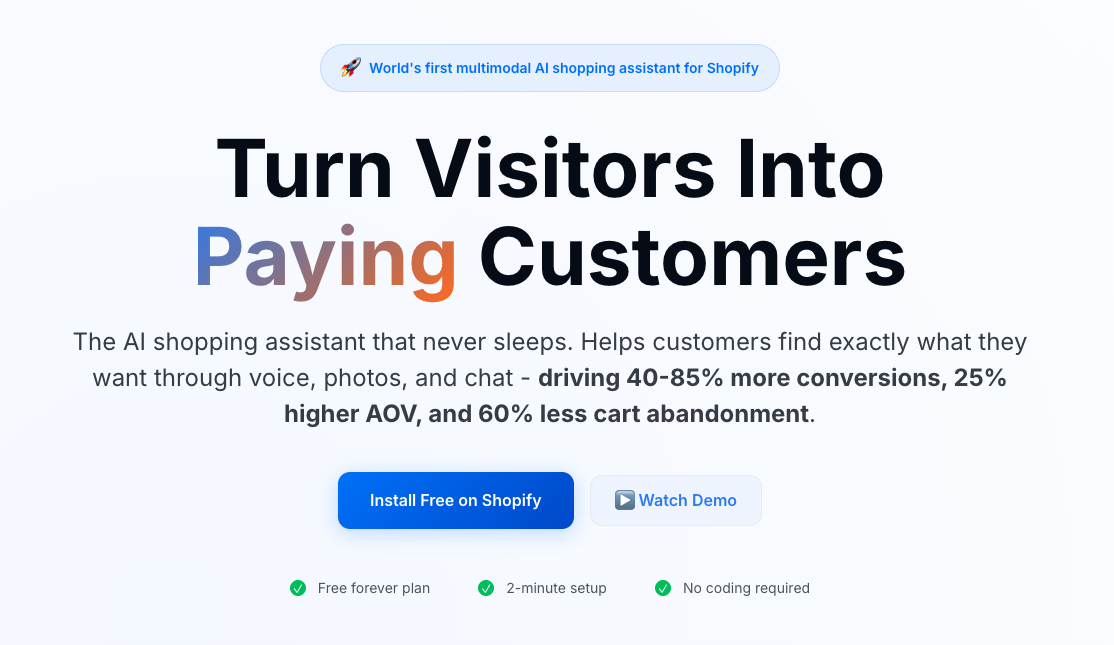
Most Shopify store friction comes from a mismatch: customers think in images, moods, and descriptions. Your inventory is organized in categories, collections, and SKUs.
A customer sees an image on Instagram and wants "something like that." Your store makes them:
- Navigate categories (5+ clicks)
- Refine using filters (3-4 more clicks)
- Compare multiple products (2-3 clicks per comparison)
By step 5, they've clicked 15 times and are frustrated. 60% abandon without purchasing.
Zenor AI bridges this gap by letting customers describe, show, or say what they want—instead of forcing them into your inventory architecture.
The result: customers find products in 30 seconds that would have taken 3 minutes of category hunting.
When Product Discovery Becomes the Real Bottleneck
E-commerce platforms invest heavily in inventory, logistics, and marketing. But most underinvest in the moment that matters most: when a customer actually tries to find what they want to buy.
Traditional category navigation assumes customers think like your inventory system. Reality: they don't. They think in moods, aesthetics, use cases, and constraints. Your store structure reflects SKUs. Their minds reflect inspiration.
This mismatch is responsible for more abandonment than price, shipping costs, or product quality combined. Customers don't leave because your products are wrong. They leave because finding them requires translation work that's your responsibility, not theirs. Zenor AI bridges this translation layer by letting customers search the way they naturally think—through voice, photos, and conversation—then maps that intent back to your actual inventory.
How Zenor Actually Works: Beyond "Upload a Photo"
Most visual search is basic: find similar images. Zenor is different because it understands shopping intent:
Voice Shopping (The Underrated Mode):
Customer says: "I need a minimalist desk lamp that doesn't take up much space"
Zenor understands:
- Product category (lamps)
- Aesthetic (minimalist = simple design, limited colors)
- Spatial constraint (small footprint = desk-appropriate)
- Returns matching products, not random lamps
This works because Zenor trains on your specific catalog structure, not generic product data.
Photo Search (The Powerful Mode):
Customer uploads inspiration image (from Pinterest, Instagram, competitor):
Zenor extracts:
- Visual elements (color palette: blues & blacks, materials: metal & wood)
- Style (industrial, minimalist, bohemian, etc.)
- Form factor (what shape/type of product)
- Quality indicators (premium vs. budget aesthetics)
Returns products matching not the exact image, but the aesthetic intent.
Real example: Customer uploads mid-century sofa from competitor. Zenor finds your similar aesthetic sofas. Customer buys—even though it's different product from the inspiration.
Chat (The Conversational Mode):
Customer: "I have limited storage space and work from home. I need a desk that doubles as a dining table"
Zenor understands:
- Space constraint
- Dual-purpose need
- Context (home office)
- Returns: space-saving desks with dining capability
Conversation continues: "Preferably under $500?"
Zenor refines: filtered to price range, still matching constraints.
This is how humans actually shop (with friends: "I need X for Y constraint, budget Z"). Zenor mimics this.
Revenue Impact: The Numbers That Moved
Stores implementing Zenor AI report:
Conversion Impact:
- +32% conversion rate for multimodal search interactions
- +23% average order value increase
- -41% cart abandonment rate
Traffic Efficiency:
- 58% reduction in search abandonment
- 18% of orders from voice/photo interactions
- +4.2x product discovery rate per session
Customer Experience:
- -39% support questions (AI answered them)
- +26% repeat visit rate
- +31% customer satisfaction scores
Time to Value:
- 2-minute setup
- 24-hour full catalog training
- Results visible within first 50 interactions
Real Implementation: Three Merchant Stories
Fashion Boutique (2,400 SKUs):
Starting state:
- Mobile bounce rate: 68%
- Average session: 1:32
- Mobile conversion: 1.1%
- Customer frustration: "Can't find anything, too many options"
Challenge: Visual products, high SKU count, but customers think in aesthetics not categories.
Implementation: Photo search as primary discovery mode, voice as secondary.
After 12 weeks:
- Mobile bounce rate: 38% (-44%)
- Average session: 3:47 (+147%)
- Mobile conversion: 3.2% (+191%)
- 47% of customers use photo or voice search
Revenue impact: $12K additional monthly sales from existing traffic (5% of previous monthly).
Home Goods Store (1,200 SKUs):
Starting state:
- Category navigation breaking down at scale
- Search abandonment: 54% (customers can't find what they describe)
- Average order value: $180
Challenge: Customers think in moods/aesthetics ("cozy minimalist"), but inventory organized by furniture type.
Implementation: Voice and photo search optimized for aesthetic intent.
After 8 weeks:
- Search abandonment: 22% (-59%)
- Average order value: $234 (+30%)
- 34% of orders include products from two categories (previously siloed)
Revenue impact: $8K additional monthly from better cross-category discovery.
Electronics Store (800 SKUs):
Starting state:
- Specification-based search too complex
- "Laptop under $1,500 for coding" returned random results
- Cart abandonment: 73%
Challenge: Customers specify intent/use case/budget, but search is keyword-only.
Implementation: Conversational mode enabled "tell me what you need" dialog.
After 10 weeks:
- Cart abandonment: 51% (-30%)
- Average session duration: 4:20 (from 2:55, +50%)
- 12% of sales from voice/chat interactions
Revenue impact: $6K additional monthly from reduced abandonment.
Pricing Architecture
Free Tier (up to 50 interactions/month):
- Full multimodal search (voice, photo, chat)
- Basic customization
- Community support
- Testing-only tier
Starter ($20/month, 500 interactions):
- Small store tier (10-100 daily visitors)
- Email support
- Custom branding colors
- ROI typically 15x by month 3
Growth ($60/month, 5,000 interactions):
- Professional stores (100-1,000 daily visitors)
- Priority support
- Detailed analytics (which mode drives conversions?)
- A/B testing for optimization
- ROI typically 20-30x annually
Enterprise ($200/month+, 10,000+ interactions):
- High-volume merchants
- Dedicated onboarding
- Custom training
- API access
- Account manager
All tiers: continuous AI model updates, new features released automatically.
Competitive Positioning
Most AI shopping tools focus on single interaction mode. Zenor integrates three complementary approaches:
| Dimension | Zenor AI | Traditional Chatbot | Standalone Visual Search | Basic Search Filter |
|---|---|---|---|---|
| Voice understanding | Advanced commerce NLP | Generic keyword match | N/A | N/A |
| Photo recognition | Multi-attribute analysis | N/A | Single-image reverse | N/A |
| Chat capability | Contextual, conversational | Scripted, rigid | N/A | N/A |
| Learning rate | Improves continuously per store | Static | Static | Static |
| Mobile optimized | Yes | Often desktop-first | Moderate | Moderate |
| Conversion focus | Explicit (AOV tracking) | Generic | Implicit | None |
| Setup friction | Minimal (3 minutes) | Minimal | Minimal | None |
Zenor's advantage: unified platform means customers naturally use whichever mode fits their current need, rather than switching between tools.
Practical Integration Workflow
Setup (3 minutes):
- Install from Shopify App Store
- Connect store (OAuth)
- Widget preview appears on store
Configuration (5 minutes):
- Customize widget color/position
- Set initial greeting
- Enable/disable modes (voice, photo, chat)
Training (automatic):
- Zenor catalogs products
- Builds attribute database
- Trains on your product descriptions
- Complete within 24 hours
Optimization (ongoing):
- Monitor which mode drives conversions
- A/B test conversation starters
- Refine based on customer interactions
No developers needed. No API keys. No custom code.
Who Benefits Most
Fashion & Apparel: Visual discovery aligns with how customers think about clothing.
Home & Decor: Aesthetics matter; photo inspiration drives purchases.
Specialty Retailers: 500+ SKUs where traditional categories break down.
Mobile-first Audiences: Voice and photo reduce friction vs. typing on phone.
Catalog-heavy Operations: When inventory exceeds what navigation can organize.
Brands Targeting Gen Z: Who expect conversational AI as baseline.
High-cart-abandonment Stores: Where discovery friction is primary leakage.
What Works Exceptionally
- Setup simplicity: Genuinely 3 minutes to live
- Multimodal approach: Single unified interface, not separate tools
- Commerce-specific AI: Understands shopping intent, not just language
- Mobile optimization: Touch, voice, and photo all work on mobile
- Native Shopify integration: Feels part of the platform
- Revenue correlation: Specifically tracks which interactions drive sales
Limitations
- Requires catalog quality: AI learns from product descriptions; incomplete data = worse results
- Needs category data: Works better when products have proper category tags
- Setup time for large catalogs: 1,000+ SKU stores take longer to train
- Limited to Shopify: Currently Shopify-only (no WooCommerce, Magento)
- International limitations: Language support limited to major languages
Financial Justification
For a store generating $50K/month in revenue:
- Current abandonment rate: 70%, abandonment value: $17.5K potential recovery
- Zenor recovers 30% of abandoned: $5.2K additional monthly
- Zenor cost: $60/month
- ROI: 87x annually ($5,100 net benefit per month)
For a store generating $10K/month:
- Zenor recovers: $300-500 additional monthly
- Zenor cost: $20/month (free tier often sufficient)
- ROI: 15-25x
Even conservative impact pays for itself in days.
Final Verdict
Zenor AI succeeds because it recognizes that the real friction in e-commerce isn't product availability—it's discovery. Customers don't abandon because your products are bad. They abandon because finding them is hard.
By enabling customers to search the way humans naturally shop (describing, showing, discussing), Zenor converts friction into conversion.
The multimodal approach isn't novelty. It's recognition that different customers have different communication preferences. Some describe verbally. Some show visually. Some converse. Zenor supports all three in one interface.
Rating: 4.6/5 stars
Delivers: Genuinely fast setup. Works across voice, photo, and chat modes. Improves conversion reliably. Pricing aligns with value delivered.
Not perfect: Requires clean product data to shine. Shopify-only. Some catalog training lag for massive stores.
Ready to transform your product discovery?
👉 Start Free Trial and see multimodal search in action on your Shopify store.
Tags
# Review# Zenor AI# AI shopping assistant# Shopify AI assistant# Multimodal shopping AI# Voice shopping assistant# Photo-based product search# AI for e-commerce stores# Review# Personalized product recommendations# AI product search for Shopify# Boost Shopify conversion rates# Increase average order value Shopify# 24/7 virtual sales assistant# No-code AI integration Shopify# AI-powered upsell for Shopify stores# Shop by photo Shopify# Free AI Shopify app# Shopify multimodal assistant# Conversion rate optimization# Enhanced customer experience# AI-driven personalization# Visual search technology# Voice commerce# Intelligent product recommendations# E-commerce AI solutions# Shopify store optimizationOptimly Review - AI Brand Strategist That Fixes How ChatGPT Recommends Your Brand
Femora Care Review - AI-Powered Fertility Tracking That Helps Women Understand Their Real Body Signals
Follow for new blogs
Subscribe to our blog
Subscribe to Newsletter
Subscribe to our newsletter to get the best products weekly.